
This is the third post in a three-part series about Dr. Eugene A. Stead Jr. (1908-2005), professor and chair of the Department of Medicine at Duke University School of Medicine from 1947 to 1967. To spotlight the addition to and reprocessing of the Eugene A. Stead Jr. Papers, this post will discuss how the Archives preserved the scrapbooks and the steps we took to maintain context while separating materials for preservation.
The first post introduces Stead, highlighting his accomplishments and career.
The second post delves into Stead’s family life contained in the scrapbooks and family albums recently added to the collection.
In 2020, the Archives received an addition from the Physician Assistant Historical Society of mostly photographic materials, including thirty albums and scrapbooks likely assembled by Stead’s wife, Evelyn Selby Stead, who methodically documented the history of their growing family alongside Dr. Stead’s professional activities. The albums contain photographs, clippings, ephemera, programs, pamphlets, correspondence, and children’s artwork, and they are organized by assigned numbers in the Albums Subseries of the Photographic Materials Series.
Duke Medical Center Archives intern Emma Eubank began processing this accession in early 2025, and intern Kayla Cavenaugh completed the addition of materials and publication of the finding aid in June. In addition to creating a processing plan and preserving Untitled Albums 1 through 7, Emma updated the collection’s arrangement, described materials that had been previously described only by their accession identification number, and renamed a selection of series to better identify the contents within. Kayla continued Emma’s preservation workflow for the remaining albums, wrote additional description, and published the revised finding aid.
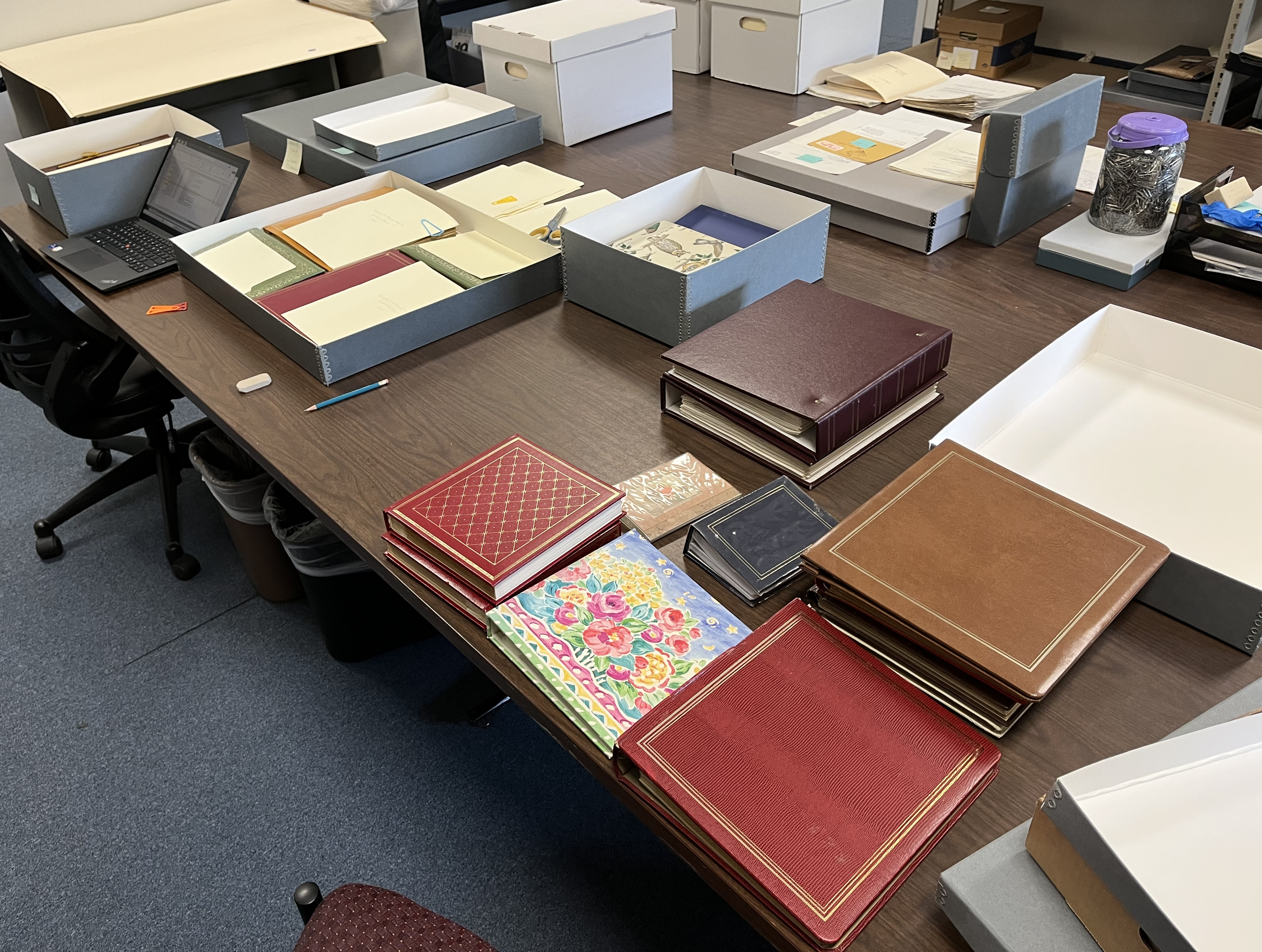
A view of many of the Stead albums spread out in the processing room at the Archives.
To begin processing any accession at the Archives, we start with a processing plan. Processing plans are an iterative tool to help an archivist build access to materials in a timely and meaningful manner. They enable us to gather information and assess the condition of a group of items, and they help us think through the eventual arrangement (organization) of new materials within an existing collection, note any preservation actions that will need to take place, and estimate the length of time processing will take.
Preserving scrapbooks takes careful planning, and we were faced with a question: How do we systematically preserve thirty scrapbooks, and retain the information contained therein, while not disturbing the original material’s context? No two collections containing scrapbooks have the same method of preservation because of the physical variables at play, ranging from adhesive degradation, to the acidity of pages used for mounting, to the variety of treatments based on type of ephemera (a dog tag has different needs from a pressed flower, for example). Additionally, individual items found in albums build layered meanings based on their relationships with other materials spanning across several pages and even across albums.

Untitled Album 12, page 60. Ephemera dated 1898 and 1977, including a metal tag for a (probable?) dog named Roddy.
The albums arrived at the Archives untitled, so numbers were assigned to each one, as well as their pages, at the time of processing. The paper used for mounting materials in many of the albums was very acidic due to its high lignin content; brittle, crumbling pages became a pressing concern. Because of the large number of albums involved in this addition, we decided, in the name of preservation, to digitize the most fragile ones to prevent future deterioration from continued use. We moved loose pieces tucked in albums or that had fallen away from their original placement on the page into labeled, acid-free envelopes, paper enclosures, and folders. In doing so, we reduced our own impact on the albums, preserving the web of relationships between materials, while ensuring items were saved from falling out, being lost, and/or losing their context.


Unfolded correspondence from Untitled Album 12, page 60. Evelyn’s mother’s cousin, Walter, sent her this letter when they were children in 1898. This letter was tucked in an envelope with other family ephemera, including a tag from a dog’s collar.
When creating a digital scan of a page, we left items securely glued to the page undisturbed, including many photographs. Items stored inside envelopes, if the envelope was securely mounted to the page, also remained undisturbed. (One outlier to this standard was the 1898 letter from Evelyn’s mother’s cousin.) Documents that were secured to pages with metal fasteners (your standard paperclip) were removed from the albums and foldered with other loose pieces; rusty paperclips were discarded. During scanning, an effort was made to unfold small news clippings, open greeting cards, and flip pages of smaller bound photo albums, correspondence, and documents, thus requiring multiple image files to capture a single scrapbook page. 

Untitled Album 2, page 65. Ephemera dated around 1952. Two images were created for this page to accommodate Nancy’s intricate folded Mother’s Day card. Image files were named MC_0024_A2_007_042_065_1 and MC_0024_A2_007_042_065_2.
Users of this collection may browse Untitled Albums 1 to 15 digitally, while the remainder of the albums are sturdy enough to be handled. In 2024, the Archives preserved two scrapbooks in the Robert L. Blake Papers, and we adapted this experience as a foundation for naming digital scans of the Stead albums, linking the filenames assigned to images of each undisturbed page with the physical location (box, then folder number) of any newly housed loose materials. (Untitled Album 9 did not have loose materials, so for these images we linked the filename with the box housing the physical album itself.) We also created an inventory for each scanned album and collected metadata for all image files, including filenames and file paths, date ranges, descriptions, notes concerning the album’s physical condition, and any HIPAA restrictions. (We located one scrapbook page with a HIPAA restriction; in this case, we appended the filename with “RESTRICTED” and separated the associated image from the other digital scans from the same album by sequestering it in its own restricted folder. The loose physical items related to this scrapbook page were moved to the Restricted Materials Series.)
By documenting all processing steps along the way, future interns and processing archivists at Duke Medical Center Archives can continue to adapt our scrapbook preservation workflow as needed, while facilitating meaningful access to these complex materials for researchers.
The Eugene A. Stead Jr. Papers reflect Stead’s personal and professional life in his correspondence, subject files, grant materials, writings, speeches, manuscript materials, certificates, awards, photographs, family albums, clippings, and audiotapes.
For more about the Archives’ holdings, search and explore our finding aids or collection guides.
For any questions, contact the Archives staff.
This blog post was contributed by Medical Center Archives Intern Kayla Cavenaugh.